
Last year, the American Psychiatric Association for the first time added moral injury to their update of the Diagnostic and Statistical Manual of Mental Disorders (DSM).
To experience moral injury is to be forced to act in ways or to witness actions that contradict your most deeply held convictions.
You can sustain moral injury in one catastrophic event, like hurting an enemy combatant in an armed conflict you don’t believe is just. It can also appear after a slow crescendo of moral distress, as people who work in slaughterhouses or prisons report. Easily mistaken for depression, moral distress frequently presents as sadness or feeling like a bad person.
In his new book, Moral Injury: When Good Conscience Suffers in a World of Hurt, Michael Valdovinos, a former US military psychologist, points out this “unique kind of stress” in overwhelmed medics early in the Covid-19 pandemic who felt they had betrayed their oath to do no harm, and in his own crisis of conscience while deployed to Afghanistan.
“The military helped us recognize moral injury, but the psychological mechanisms obviously aren’t unique to war,” says Valdovinos. “Anytime people repeatedly participate in or witness actions that violate their moral framework and they feel unable to change it, you create the conditions for moral injury.”
Now, Valdovinos suggests, the wild political situation in the US is leaving more citizens in moral distress than ever before – but the key to feeling better also lies in other people.
This interview has been edited and condensed for clarity.
How did you end up working as a military psychologist in Afghanistan?
I grew up in a very small town in northern California. My parents immigrated from Mexico with third and fifth grade educations. Graduating high school felt like a significant event, and I’m the first in my family to ever even go to college.
In my second year of grad school, my adviser came to me and said, there’s this great opportunity in the air force. I ended up getting it, then commissioned in, and very quickly got licensed. Then the news came that I was going to get deployed to Afghanistan. I was going to be part of the team overseeing the Geneva convention as it relates to interrogation and detention operations. If you remember, prior to Obama, there was a lot of enhanced interrogation techniques. Abu Ghraib, all that bad stuff.

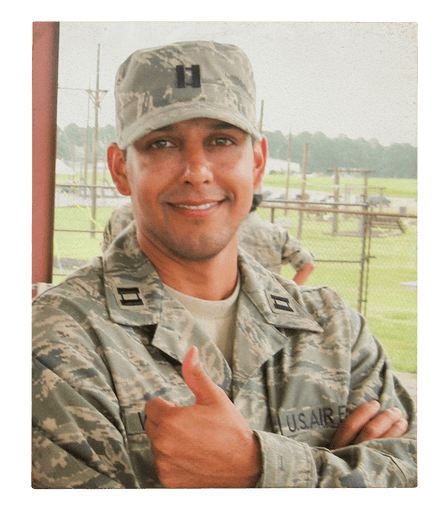
It’s still pretty hard for me to talk about, but I think it’s cathartic. I started to look for any semblance of any normalcy, any semblance of things that I could remember that reminded me of me. And it was that damn farm. The base was concrete all around, with chain link fences. Then you see this mirage. You see this farmer. I saw sunflowers blowing in the wind. Big, beautiful ones. I saw vegetables. It reminded me of Mexico and my family and my dad. And then it literally felt like someone dropped a 12 by 12 concrete slab on top of me.
I just started bawling. I’m in full uniform holding on to a chain link fence looking out, just bawling. I think if another officer would have walked by and seen me, he would’ve been like: “Dude, did you lose your mind?” Let alone as a psychologist – can you imagine? I just felt like, what do I do now? We’re three weeks in.
You had experienced moral injury.
I had no idea at the time. I just felt – I thought it was sadness. I was sad, right? And then I felt bad about myself. So, that’s when I looked on the computer and started Googling it, and I came across the word.
Part of the challenge of writing this book is that we don’t have super formalized assessment and diagnostic pathways for this yet. It was just added by the American Psychiatric Association to the DSM under religious, spiritual and moral problems. Now it can formally be documented – moral distress, moral injury, moral dilemmas – and classified.
So we’re getting to a place where this will be completely evaluated and diagnosed as its own mental health condition. We’re not there yet.
Did they assign you any reading about moral injury, like Jonathan Shay’s Achilles in Vietnam (1994), when you studied psychology with the military?
No. I think that part of the reason that moral injury and Shay didn’t really catch on was that the military for some time was grappling with the idea that if this becomes more formalized and we acknowledge it, there is a lot of back-pedaling that we need to do. The military now has moved forward with acknowledgment of that, and they’ve supported research in it. But I think early on, it was this almost running joke that the military is never going to formally acknowledge this; can you imagine what they would have to do for benefits and evaluations of people?
But I’d be hard pressed to think at this point of people in the military, particularly in mental health circles, that don’t recognize that every war has a moral interest component to it, particularly Vietnam. I mean, you can look at Iraq, you can look at Afghanistan – you know, it’s not a secret any more.
In his book Dirty Work: Essential Jobs and the Hidden Toll of Inequality (2021), Eyal Press suggested that jobs that come with a lot of risk for moral injury, like slaughtering farm animals or social work, tend to be badly paid. Where else in society do you see moral injury showing up, beyond the military and politics, and what can people do about it?
People experience moral injury from carrying out harmful actions. But there’s also another group that experiences it from authorizing or enabling them. That’s why moral injury is starting to show up among leaders, executives, policymakers.
Moral injury is conscience-based. It’s shame and guilt. And so there’s a natural inclination for us as human beings not to show our cards, because it can be embarrassing. It can feel like weakness. It’s painful to sit with that reality. But unfortunately the best science tells us right now that that is part of the repair.
And in fact, when you seek that in community and recognize that the community is there to support you, it’s one of these beautiful things that we’re watching happen through research. In fact, it leads to healing. I think that says a lot about our humanity, and moving forward, the research will be really interesting in terms of how it evolves for civilians.
We don’t yet have national prevalence numbers for moral injury. But based on our best data and epidemiological anchors, I think a rough estimate is probably about 3 to 7% of US adults that may be experiencing clinical symptoms of moral injury in any given year. That might seem like a little number, but you’re talking about the order of seven, eight to 18 million people. And I don’t think that’s far-fetched.
I do encourage you to try to seek out the people that you trust and don’t just assume that they don’t feel similar. You might help them recognize something in themselves that they are not seeing. A lot of people think they’re depressed, or just inherently bad people. It’s not PTSD; it’s not anything else. It’s almost as if they’re suffering from depression. And you’ve got to be aware to be able to parse out the differences.
You argue that there can be a kind of collective moral injury. You don’t name Donald Trump, but you do name changes like the promotion of greed in public life. Was it difficult for you to choose your words there?
It was hard. I didn’t want to sugar-coat the reality of our situation. And my fear was that writing a book that was too leaning in one direction or another was going to shut off a certain segment of the population.
I still operate within pretty large clinical circles, where upwards of 30% of clinicians’ patient panels are people coming in just for moral distress, and many of them are not liberals or Democrats. The more the line gets pushed – promises not kept, blatant violations of decency and normalcy and traditions and customs and courtesies, that for the most part we’ve held for eons – the more that folks in these circles have a disconnection between the way they see themselves and their values and what they thought their party was. And I think that that’s happening at a rate that we haven’t seen in years past.
The silver lining about everything that’s happening with the administration and global affairs is that there are so many plentiful examples of dissonance now that people are now going, huh? They’re rethinking their moral compass left, right and center.
How could you help a Maga relative, for example, who you thought showed symptoms of moral injury, but had difficulty hearing that?
A patient I saw for this very issue, their moral distress was wreaking havoc on their relationship with family members. One of the things that I really tried to do with the daughter was to proactively engage, not provoke, but engage the parent. I hope it doesn’t sound too general, but it really is a fundamental first step, to lean in and show somebody that you care; that they can be heard, understood and listened to, in a way where you’re asking questions, not making statements, not making judgments.
In that way, psychological safety is established, which is super important for these folks. There’s a fear that, if I’m no longer a part of this group – as human beings, we all gravitate towards groups, whether we like it or not – then what does that mean? Where do I belong?
What I’m noticing, and I think a lot of clinical colleagues have, is that overwhelmingly their practices are getting filled with older folks coming to treatment for moral distress. They have a longer memory of how things used to work. Many grew up believing in certain norms about institutions, leadership and basic behavior. When those expectations are repeatedly violated, it can feel deeply destabilizing. Not just frustrating, but like something fundamental has broken. It feels like a betrayal, and that is a pathway to moral injury.
Moral Injuries: When Good Conscience Suffers in a World of Hurt by Michael Valdovinos is out now via HarperCollins
-
Jo Livingstone is a nonfiction writer and critic who lives in New York