
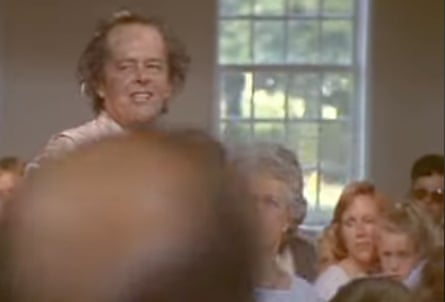
I clearly remember the first time I had a soda because it was the same day Jack Nicholson threw up on me. Deliberately. He’d burst through the doors of a church and began a profanity-riddled tirade against God and women as he gesticulated madly and accosted churchgoers.
When he reached the front row where I sat and turned towards me, I froze. His eyes were abnormally alert, his hair wild and uncombed and saliva dripped from his mouth like a Neapolitan mastiff.
Suddenly, the director yelled “cut!” and Jack grinned at me before giving my nose what can only be described as a boop and walking back down the aisle and out of the church. The costume department immediately descended on the congregation, wiping the cherry pulp and juice “vomit” off our clothes to reset the scene.
It was the summer of 1986 and we were in Cohasset, 20 miles outside Boston, shooting one of the most memorable and dramatic scenes in The Witches of Eastwick, a film starring Jack Nicholson, Cher, Michelle Pfeiffer and Susan Sarandon. Jack played the devil and this scene was one of his most devilish, neither of which I knew before agreeing to be an extra.
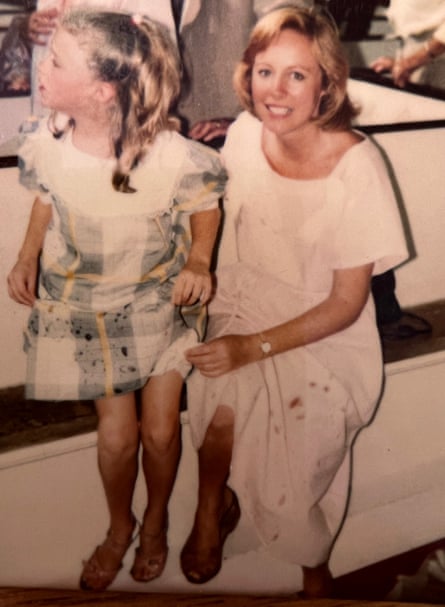
I was warned it would involve being thrown up on but I knew it was only “movie” vomit and that I’d get paid $100. For a seven-year-old Australian girl on her first trip to the US, it sounded like a fun way to spend the day. It certainly beat spending it in our hotel room doing schoolwork.

Up until this point, I’d lived my whole life in Australia, with little insight into my dad’s job other than he worked long hours editing films and TV shows. But when he started getting work overseas, and we began moving frequently between cities, countries and schools, his work intertwined more with my life.

Working on a movie set involves an enormous amount of waiting: waiting for everyone to get through hair and makeup, waiting for shots to be set up and then waiting again for them to be reset at the end of each take. That level of patience didn’t entice seven-year-old me – but the craft service certainly did.
Functioning like a gratis convenience store, this magical table was laden with every imaginable treat a child could hope for: candy bars, chocolate, bubble gum, chips, bagels, pastries, lollipops, fruit and biscuits, flanked by giant tubs of soda. Brightly coloured cans of Cherry Coke, 7-Up, Sprite, Ginger Ale and Dr Pepper rested on ice. You could take whatever you wanted, whenever you wanted, without asking.

My packed school lunches might usually consist of a capsicum cheek and yoghurt with sunflower seeds. A chewable vitamin C tablet felt like a sweet, so the craft service table was my idea of heaven.
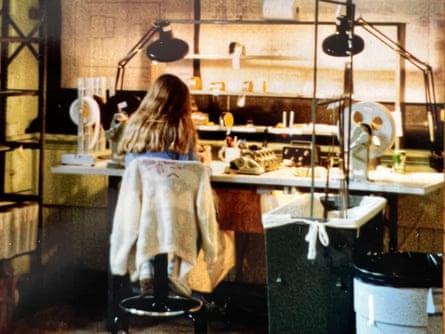
Over the years, the novelty of craft services faded and I became more interested in what happened off set. When I was a teenager I’d finish my correspondence schoolwork usually by Wednesday of each week then spend the remaining two days in my dad’s cutting room, helping prepare footage for him to edit. I loved the solitary, detailed focus of sitting at the workbench all day manually coding, reconstituting and syncing reel after reel of 35mm picture and sound.
I visited Dad on various sets: the boat sound stage for Dead Calm, an airplane for Air Force One, the massive water tank set of The Perfect Storm, and the creepy prison in Ohio used for exterior shots in The Shawshank Redemption.
I also spent time on scoring stages watching composers direct orchestras for the soundtrack, viewing “dailies” or “rushes” (the raw, unedited footage shot the day before) and sitting beside to Dad’s Steenbeck (and later his Avid – when film stock moved to digital) to watch scenes he was working on before we went out to lunch.
It shouldn’t be a surprise to anyone (although bizarrely it was to me), that my first job out of university ended up being in film. In a full-circle moment, I was back on set, as a production assistant on Harry Potter and the Philosopher’s Stone.
Of course, I spent a lot of time hovering near the craft service table.