
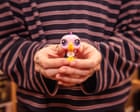
I’m standing, holding a thumbnail-sized glass owl, in front of a pink box filled with a boggling kaleidoscope of colours, shapes and textures. There’s a plush elephant wearing a green and pink sombrero; a rubber oval that is part doughnut with sprinkles, part frog; a bubble tea keyring; stickers and pins; a sparkly tangle of bracelets and much more. My mission? To swap my owl to experience first-hand the buzz of trading at a trinket exchange.
Boxes filled with tchotchkes that visitors exchange for their own trinkets are popping up everywhere. Emerging in the US last autumn (Philadelphia had one of the first using a ready-made electrical junction box, a popular format), they’re a new iteration of a phenomenon that started with Little Free Libraries and diversified during the pandemic into myriad neighbourhood installations.
Rachael Harms Mahlandt, a Portland-based artist, has been creating and cataloguing what she calls “sidewalk joy” since 2022 (her yard hosts a mug exchange, seed and stationery swaps, and a mini-library “for itty-bitty books”). She started a world map of installations in 2024 and it just keeps growing. In the past two months, the map has gone from 800 to nearly 1,500 sidewalk delights, and the UK is a hotspot. “We had one spot for the longest time, then the trinket box trade has taken off.”

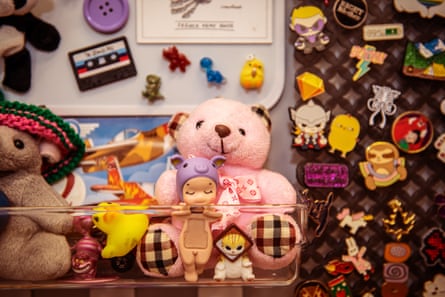
There are boxes from Blackpool to Brighton, but I’m at Argonaut Books in Leith, admiring Sam Stevens’ (@edinburgh.trinket.trade) bright pink, trinket-stuffed box. Stevens, 29, originally from Toronto, works as a pet-sitter, which means she can “do lots of extra things,” she says. “I love to do stuff with other people.” She was inspired by seeing a San Francisco trinket exchange, @sunset.trinket.trade, online: “I’m big on trinket collecting and I loved her concept.” Stevens joined a group chat for trinket trade organisers, mostly based in the US, then took the plunge from her Edinburgh home. “It was just such a fun free thing – I enjoyed designing it and putting it together.” The contents came from her own car boot sale collections: “It’s mostly been a way for me to recycle stuff.”
Although not a “trinket fiend” himself, for Adam Barclay of Argonaut, hosting the box made perfect sense: this community-centred spot does much more than sell books. In March, as part of a push to support local artists, Argonaut hosted the artist Eve Tong’s coin-operated print vending machine, which dispenses mini-prints for £1, and it was seeing this in action that inspired Stevens to ask the shop to host her trinket exchange box. The box was created specially and arrived at the start of April. Barclay says it has been “really nice”. Trinket enthusiasts come in all shapes and sizes, he says, including Argonaut staff, who occasionally raid the box: “There’s a magnetic lobster stuck on the staff whiteboard that wasn’t there a month ago …”
Stevens was confident a trinket exchange would work at Argonaut, but didn’t expect it to blow up so fast. “It felt like overnight I got 400 followers, people from the community.” Now, when she visits to check the box, she always sees people trading; others tag her online, showing their finds. “It’s so nice that people are keen to come and see it.”

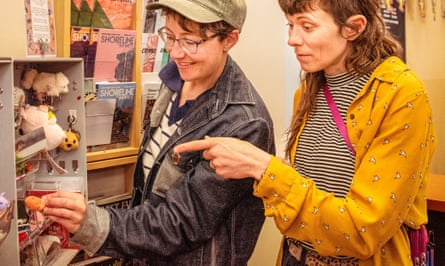
People are peeping as we speak: Franky Cannon, an artist and writer, and her artist sister, Liza, are pondering the relative merits of stickers and ceramic sheep. Argonaut is Franky’s local bookshop and she clocked the print vending machine during its residency: “That’s why I was drawn into this corner.” Now in their 30s, both enjoyed geocaching and letterboxing (forms of treasure hunting) when they were growing up, so discovering tiny treasures appeals. Franky says she’s more drawn to the “ancient, mysterious” trinkets that she finds beachcombing now, but newer stuff is fun, too: “We all need more fun in our lives.” She plumps for a crab coin purse; Liza picks a tiny rocket pin, and although they happened on the trinket exchange by chance and haven’t come prepared, Franky donates her fluorescent bike safety armband.
“I love watching trades,” says Stevens. “I like to ask them: what did you take, what did you trade for?” Almost everything in the box is now new to her, especially 90s and oos collectibles, from Pokémon to Pingu. “I think nostalgia is a big thing for trinkets,” she says. “For me, at least, it’s a huge aspect. I collect a lot of nostalgic things from my childhood: Tamagotchis, Polly Pockets and Sylvanian Families.”

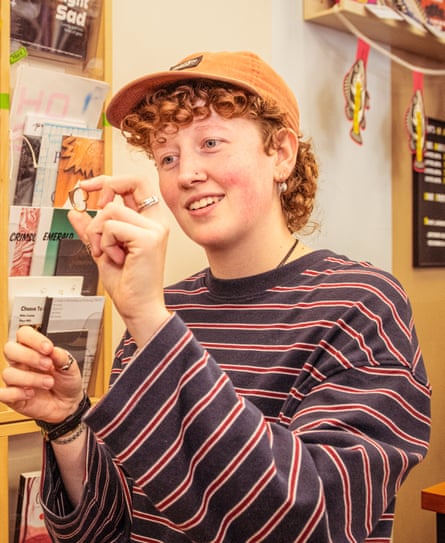
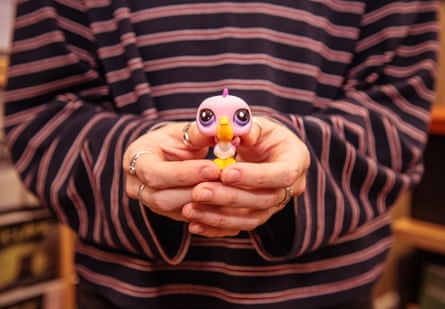
Nostalgia is drawing Noa Carter, a 22-year-old photography student, to a pink Littlest Pet Shop bird: “I’ve been collecting them since I was tiny.” She spotted the box in an online map of UK trinket swaps, but hasn’t brought anything to trade today. “I’m going to come again,” she vows. But Stevens encourages her to take something anyway – there’s no obligation to give and it all evens out. “Sometimes I come and it’s overflowing,” she says. Carter takes her bird but later she and her friend, Cameron, return with a pink stuffed mouse and a tiny diplodocus to donate. Cameron falls for a plush fish keychain, clipping it next to another fish on her backpack.
Could these trinkets be described as tat? Sure, they’re a minimalist’s nightmare, but trinket trading is a circular tat economy rather than a wasteful, over-consuming one. “It gives you that … instant gratification, that dopamine without the ecological impact,” TikTok user @alottameg, who runs a London trinket exchange, explains on the site. Stevens agrees: “It’s a way people can get a boost of joy without having to buy something, but also recycle something they don’t want any more.” She has noticed people often have emotional connections to their contributions, too. “You can tell it’s something they’ve had a long time and they’re like, ‘Someone else will love it instead of me.’”

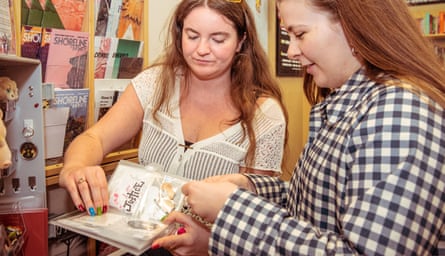
Niamh O’Connor and Ellie Millar, both 27, appear, bearing gifts. “We’ve got a wee selection,” O’Connor says. “We’ve got stickers; we’ve got a Barbie lipstick you wind up and a Ken doll pops out.” They’re on a mission, having missed out on the print vending machine. “Every time I came it was sold out,” says O’Connor. “So when I saw this [on Instagram], I said: ‘I’m going.’” We stand aside to let them trade. “This is cute,” O’Connor says, browsing. “I just want the entire box in my house.” Millar says she likes “collecting things for the sake of it … having little things and no one just telling me it’s rubbish.” O’Connor picks a baby doll wearing a purple pig hat (Sonny Angel, another 00s nostalgia figure). “It’s too cute,” she says. Millar chooses a magnetic tomato and a “Disco Cowgirl” sticker; they promise to return.
But why? Earnest analyses of the appeal of “trinketcore” say it’s escapist nostalgia; it’s whimsymaxxing (leaning into silly sources of delight); it’s an expression of what Barclay calls “the little treatification of the world”. “Collecting trinkets feels like healing your inner child,” a thrifter told the New York Post. Recent research on the psychology of collecting suggests it’s something people are drawn to in turbulent times. “People have a desire for control when times get tough, and collecting is great because it can put you in control of your little world,” says Martin Reimann, associate professor of marketing at the University of Arizona’s Eller College of Management, who studied engagement with collecting during Covid.

Another word emerges when discussing the appeal of trinkets: joy. “Things are really bad, and people just want a tiny bit of joy,” says Stevens. Harms Mahlandt agrees: “I think that the world has been really heavy … People have been rising to the occasion, but they’re tired and they need some joy.”
I’m tired and whimsy-deficient, but I do feel real childlike joy, exclaiming over other people’s knick-knacks, and deliberating what to swap for my owl (a sparkly stegosaurus magnet captures my heart). The box has now moved to another Edinburgh bookstore (Lighthouse, in the Southside area), though Argonaut is considering installing a smaller permanent one.
Stevens says she has no intention of stopping. “I’ll do it for ever if people want.” That’s wonderful news: in a world short on sparkle and silliness, as Barclay rightly says: “It’s just nice to have little things.”