
Hugh Pym,Health editorand
Tabby Wilson



British passengers and crew on the cruise ship hit with an outbreak of hantavirus will be tested before returning to the UK.
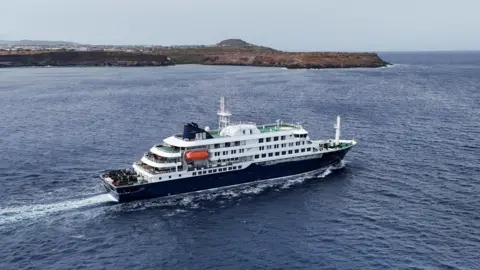
The MV Hondius is expected to dock in the Canary Islands this weekend, with the remaining 22 Britons due to fly home on a charter flight soon after.
Two British men with confirmed cases are receiving treatment in the Netherlands and South Africa, while a third Briton is being treated for a suspected case on the remote Atlantic island of Tristan da Cunha, where the ship stopped in mid-April.
Ahead of the ship’s arrival on the island of Tenerife on Sunday, government officials have been setting out plans to fly home the British citizens.
When the vessel arrives, passengers and crew will be tested for the virus onboard by Spanish officials. If they are symptomatic they will be taken to local hospitals for treatment.
Those without symptoms will be taken straight to a chartered plane and flown to the UK as soon as possible, most likely the same day.
Although none of the remaining Britons are currently displaying symptoms, they will be asked to isolate and self-test for 45 days – either at home or at other accommodation – upon their return. No legislation will be used to impose self isolation.
Support from medical staff will be available to help carry out blood tests.
He remains in a stable condition and told the BBC that he was “fine”.
Another British passenger, 69, has a confirmed case and was medically evacuated to South Africa at the end of April.
He remains in intensive care and has been said by officials to be “doing better”.
Two other British nationals are already self-isolating at home in the UK after potential exposure. They are doing so voluntarily and do not have any symptoms.
They were part of a group of 30 people from a dozen nations – including seven Britons – who disembarked from the ship at St Helena in the South Atlantic on 24 April, according to operator Oceanwide Expeditions.
The operator said the first confirmed case of hantavirus was not reported until 4 May and that all guests who disembarked the ship had been contacted.
Four Britons who disembarked on St Helena remain there.
They do not have symptoms but are in contact with health officials. It is understood that medical staff will be sent to the islands to provide support.
A military plane has arrived at Ascension Island, a British territory in the South Atlantic, with supplies of testing kits, oxygen and other medical equipment. Medical personnel are expected to take these to St Helena and Tristan da Cunha.
Contact tracing is under way in several other countries for dozens of passengers who left the Dutch cruise ship before the outbreak was detected – including Switzerland and the Netherlands.
The World Health Organization (WHO) called it a “serious incident” but said the risk to the public was low, stressing the outbreak was not similar to the Covid-19 pandemic.
British people affected by hantavirus outbreak
- Three Britons are confirmed or suspected to have contracted hantavirus
- One of them is being treated in the Netherlands, another man is being treated in South Africa, and a third is on the remote Atlantic island of Trista da Cunha
- Seven Britons disembarked the MV Hondius in St Helena on 24 April before the first confirmed case of hantavirus was reported on 4 May, with four remaining there
- Two of the Britons who disembarked on 24 April have already returned to the UK and are self-isolating voluntarily but do not have symptoms
- The seventh person has not yet been traced, the UKHSA has said
The origin of the outbreak is still unknown and it is not known if people other than cruise ship passengers and crew have been infected with the disease.
WHO director-general Tedros Ghebreyesus told a news conference that the first two cases had “travelled through Argentina, Chile and Uruguay on a bird-watching trip which included visits to sites where the species of rat known to carry the virus was present”.
One of the three deaths was a Dutch woman, 69, who left the MV Hondius when it stopped at St Helena on 24 April and travelled to South Africa where she died two days later.
Her husband died on board the vessel on 11 April, while a German woman also died on board. Neither are confirmed to have had the virus.
Hantavirus typically spreads from rodents such as mice and rats, but experts believe that in this circumstance it may have passed between humans who were in close contact.
Symptoms can include fever, extreme fatigue, stomach pain, vomiting and shortness of breath, usually appearing between two to four weeks after being exposed to the virus.
The UKHSA said the virus was not spread through everyday contact such as walking in public spaces and that in the rare instances where a person has caught it from another person, they have had “close and prolonged” contact.
Are you on the ship or do you know someone who is? If you feel able to do so, please get in touch by using this link or the form below.



Get our flagship newsletter with all the headlines you need to start the day. Sign up here.